Thursday, 3 July 2014

Overview: The Emperor & The Fours

The first step towards gaining a deeper understanding of the Tarot, and something a lot of people forget to do, is to break down the 56 minor arcana cards into 14 groups - the aces, the twos, threes, and so on. So instead of having 56 cards, you only have one set of 14 cards, each with four different suits, coupled with a card from the major arcana as an influence of those cards. In a previous post we discussed the suits and the difference aspect they symbolise, now it's just a matter or leaning the 14 different groups of cards, and their relationship with their "parent" major arcana.

In this lesson, we shall be discussing the Emperor and the fours


The Emperor & The Fours


The Emperor

 The fours relate to the emperor, signifying stability. The image of the emperor depicts him atop a throne, rams' heads suggest Aries - a symbol of strength and great plans. He is the father figure, a man of strength who could provide stability, structure and order, power and protection. At his best he is a wise leader, at his worse he is desperate. 


The Fours

Like the four corners of a building which are set out from the beginning, the fours represent the investment of passion, emotion, brain power and work - that is now rooted and established. Think of the cornerstone of a building. Before it can be grown to great heights and strengths, the groundwork is first laid. This is the hard work needed to create a solid foundation upon which to build. Or perhaps like an unfinished structure it can represent something that has to come to a halt and cease to evolve before too much effort is wasted.

The Four of Swords

The four of swords depicts a man resting with a sword at his side and three upon the wall. As the story goes before embarking into battle knights would commission a sarcophagus to be made for them in the event of their death. Upon their safe return the knight would lay in that coffin, offering a prayer to god in thanks for his safe return. The knights would use that time to reflect upon the nature of their mission and whether they served it well. The knights were aware that, but for fate, it could have been them dead in that coffin. Therefore this card represents making peace and relaxation - stepping away from the swords in battles, reflection upon what truly matters in your life. Refocusing your objectives. 

The Four of Wands

The four of wands depict a minor celebration. While the wands themselves combine to form a week foundation set safely, decorated, outside of the city walls; this card suggests success, but with further work to be done. This is not a great feast or celebration, rather the recognition of a minor triumph. As such, the celebration continues, but it must be remembered that there is more work to be done.

The Four of Cups

The four of cups depicts a man sitting comfortably, beneath a tree. He is dissatisfied and bred with the outside world, lost in thought and ignoring the gifts that are set before him. This card represents the dissatisfaction with the gifts that one has, and also stagnation - a refusal to look beyond yourself. We act this way when we take the good things we have for granted, refusing to acknowledge its goodness.

The Four of Pentacles

The four of pentacles depicts a man clinging tightly to that which he has, not investing or sharing or developing it; not holding it with joy or pride. This is a card that suggest holding back, not speaking or sharing the details, or rewards of your efforts. The good news is that the querant is in a position of status, health, money or comfort. Business may be good or stable, work is steady and money is in the bank. However the bad news is that they may be holding on too tight, or be too afraid to share what they've gained; afraid to take a chance. This is also the card of hoarders, pack rats, jealous relationships,  shut-ins, agoraphobics. It reminds the spendthrifts, or the shopaholics, to hold onto their money. It reminds the workaholic not to take on more jobs; and also reminds the miser to be more generous with good luck, and suggests that holding on too tightly to what you have can lead to stagnation and dissatisfaction.

Monday, 30 June 2014

Overview: The Empress & The Threes

The first step towards gaining a deeper understanding of the Tarot, and something a lot of people forget to do, is to break down the 56 minor arcana cards into 14 groups - the aces, the twos, threes, and so on. So instead of having 56 cards, you only have one set of 14 cards, each with four different suits, coupled with a card from the major arcana as an influence of those cards. In a previous post we discussed the suits and the difference aspect they symbolise, now it's just a matter or leaning the 14 different groups of cards, and their relationship with their "parent" major arcana.

In this lesson, we shall be discussing the threes and the Empress


The Empress & The Threes


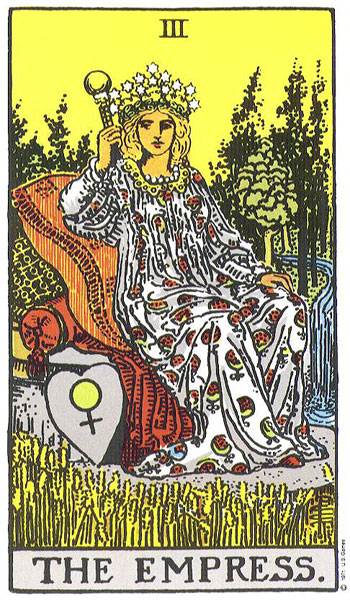
The Empress

The threes relate to the empress. The empress card depicts a woman, likely regnant, seated comfortably and lavishly in a field. She represents fertility, not just for human life but a fertility of ideas and other creations as well. Where the magician provided the spark, and the high priestess gave that spark space and time to develop into a full idea, the empress is the start of binging that idea, that spark, into fruition. That spark is n longer merely thoughts, action beings with the empress.  The empress is the great mother, the understanding sympathiser, the who who brings all things forward into the world, and helps them mature and develop. 


The Threes

So while the twos were about a choice, or a fork in the road, the threes symbolise the beginnings of taking action. This could be the creation of life, romance, art or business. These are the first affirmative steps towards the new beginning. We have chosen a path to take and we've begun upon it. We draw strength. Threes are about starting to put things into action.

The Three of Swords

The three of swords depicts a pierced heart upon the backdrop of a storm. This card may reveal heartache or pain, whether it be from love or from the disillusionment with a  closely held and highly personal belief or feeling. As the swords relate to matters of power and strength and change, the thrice pierced heart relates or reflects the death of something which is closely held. It relates to those things of great importance and likely, great impact on our public persona.

The Three of Wands

 The three of wands depicts a  man arriving at the edge of his land, he grasps on of three wands as he takes in the sights that stretch out over the horizon. He realises that the journey has just begun, but also, that there is still time to turn back - though not for long. The three of wands involves embarking upon a journey, reaching a point where you cannot turn back. It is a card of progress, the first hint that a dream may become real. However the journey has only just begun.

The Three of Cups

The three of cups depicts three maidens celebrating. Being the suit of passion, they are celebrating a joyous occasion, and three being the number of action, it's a new beginning. You are embarking on an endeavour of the heart, this could signify a birth, a new year, a new passion, or a new opportunity for your passion.

The Three of Pentacles

The three of pentacles card depicts a craftsman or tradesmen showing his work to his patrons - the people who pay for his work. Being a card of new beginnings, this may suggest further opportunity for the craftsman.  It's something you've begun to work on that will soon pay off. Your work will be rewarded. Being in the suit of pentacles this card relates to an earthly concern, it could be a focus on your health or your property, or the work on a relationship.  A new beginning stemming from past work, or effort.


Overview: The High Priestess & The Twos

The first step towards gaining a deeper understanding of the Tarot, and something a lot of people forget to do, is to break down the 56 minor arcana cards into 14 groups - the aces, the twos, threes, and so on. So instead of having 56 cards, you only have one set of 14 cards, each with four different suits, coupled with a card from the major arcana as an influence of those cards. In a previous post we discussed the suits and the difference aspect they symbolise, now it's just a matter or leaning the 14 different groups of cards, and their relationship with their "parent" major arcana.

In this lesson, we shall be discussing the twos and the High Priestess

The High Priestess & The Twos


The High Priestess

This card depicts a woman seated between two pillars marked B and J, this represents the word and phrase inscribed upon the pillars in King Solomon's temple. Those words are Boaz and Joachim, the words can loosely be understood to stand for strength and unity. There's a cloth behind the high priestess depicting pomegranates, a sign of prosperity and ambition to the Egyptians, and a symbol of death and the after life to the Greeks. The high priestess holds a scroll, as a keeper of secret knowledge. She holds down the moon, a symbol of mystery, beneath her foot. She does not represent creation, but rather inspiration - the middle ground between the idea supplied by the magician,  and the creation which will be inspired by the empress. 


The Twos

The number two suggests duality, a point between two choices, a fork in the road, our decision as to whether or not a new path will be taken. Twos are the fork in the road. Do you follow the path which takes new ideas into fruition, or do you take the other route? The twos also represent instinctual wisdom, the twos are undirected energy, pure potential waiting to be channelled into a new direction. Do you dare to explore your options.


The Two of Swords

The two of swords show the image of a blindfolded woman with crossed swords, suggesting a clash of ideas or words. Whilst remaining impartial, she holds the swords apart. The querant may feel in the middle of something, caught between two warring people or ideas within their mind. Whilst not choosing sides, the two of swords remains in the middle, at that crossroad, possibly being torn between the two choices.

The Two of Wands

The two of wands shows an image of a man standing with the world in his hands, but it isn't the world s a whole - it's his personal world. He stands between the two wands, his eyes looking exactly between the world he holds in his hands and that which lies beyond. Again, it's a struggle between choices, a journey to be set upon, not for fear nor love nor necessity, but for its own sake.

The Two of Cups 

The two of cups shows two people together, sharing, with one figure taking the cup of the other in exchange. These people are friends, or acquaintances coming together, an unexpected meeting which can change the course or direction. In the background you can see the intertwined snakes, kaduceus. This symbol represents the Roman God Mercury, who was said to watch over the trades. It's a recognised symbol of commerce and negotiation, knowledge of the trades, practical skills, writing and eloquence. So really, the two of cups has a wide spectrum of interpretation. Coming together, brotherhood, trades people, sharing, changing direction.

The Two of Pentacles

The two of pentacles shows the image of  man juggling two pentacles - trying to keep the other from falling, with the balls being tied to a symbol of infinity. The juggler is balancing the physical aspects of his life, be they health, finances or perhaps security. The man seeks to maintain the balls in motion, constantly making choices to keep his life in balance.

Overview: The Magician & The Aces

The first step towards gaining a deeper understanding of the Tarot, and something a lot of people forget to do, is to break down the 56 minor arcana cards into 14 groups - the aces, the twos, threes, and so on. So instead of having 56 cards, you only have one set of 14 cards, each with four different suits, coupled with a card from the major arcana as an influence of those cards. In a previous post we discussed the suits and the difference aspect they symbolise, now it's just a matter or leaning the 14 different groups of cards, and their relationship with their "parent" major arcana.

In this lesson, we shall be discussing the aces. In Tarot the aces are the number ones, they relate to the Magician from the major arcana.

The Magician & The Aces


The Magician

The Magician stands behind his alter with all of the suits in front of him, we see the swords, wands, cups and pentacles. Why? It is because the Magician is the creator of idea and thought. He is the one through which everything begins. This is not the physical creation - (that's the Empress) - this isn't about the breathing of life into ideas, but the very inception of them within the human mind. The aces are the root, or the beginning of every suit, as such it should be pretty intuitive that they symbolize the very first kernel of a new beginning in some aspect of the querant's life. Not the beginning of work, but the very first inkling of a thought that perhaps something of change, perhaps for the better. The Magician is the one who conjures ideas and inspiration from our mind, as if by magic. To me, there is something weird about this idea, and it's really hard to explain. So focus carefully here. The Magician will conjure a thought, for you, and he asks the impossible question: what type of new thought would you like to receive? What theme should I plant in your mind? Well... how can you answer that? Obviously, you can't. The aces represent these types of beginnings that come from some strange, fuzzier, hazy place in our mind that we are scarcely aware of. They are the exposure in the beginning of adoption of a new idea, way of being, or thinking.


The Ace of Swords

The ace of swords represents awakening, a beginning to new large challenges. There may be an awareness of the querant that there's a new challenge or a new goal of epic proportions that is ahead of them. They may just be beginning to see the challenge, or the may have just begun to work towards or away from this occurrence, radically altering their action in light of this new idea or influence.


The Ace of Wands

The ace of wands represents a new passion, it could be religious, philosophical, relating to career about which they're passionate. It could be a new journey, a new battle to overcome, or a new love in their life. Remember, a new love is about passion. As we already know wands relate to that which we're passionate about. Ace of wands represent a new passion somewhere in the querant's life.


The Ace of Cups

The ace of cups represents a new love. This could be romantic love, or a deep passion for an endeavour or idea. They are intrigued, and excited. They are looking forward to the new, not just with their eyes but with their hearts. They feel the pull towards something new and exciting, it captures their imagination and dreams.


The Ace of Pentacles

 The ace of pentacles represents new luck, new luck, new prosperity. It's not flashy or ostentatious, nothing short lived or elusive. The ace of pentacles represents new but solid gains to be made in one's physical self, or the physical world around them. These are long lasting changes such as new friendship, new prosperity or new found health.

Overview of Tarot Suits

To make learning the 78 Rider-Waite Tarot cards easier, I am choosing to first break the cards down into groups. Firstly we divide the cards into two sets - the major and the minor arcana. The major arcana consists of twenty two cards, and each has a number, the first 10 are:
  1. The Magician
  2. The High Priestess
  3. The Empress
  4. The Emperor
  5. The Hierophant
  6. The Lovers
  7. The Chariot
  8. Strength
  9. The Hermit
  10. The Wheel of Fortune
Why is this important? It is important, because each of those 10 cards act as parents for their corresponding numbers within the minor arcana. So if we take The Hierophant - he relates to all the fives within the minor arcana - The Lovers relate to the sixes, and so on. So right there, when doing a Tarot reading, you already have two pieces of information to draw upon for any card that comes up. You'll have two different ways of interpreting it based on the card itself and also to the part on the minor arcana to which it relates. For this reason, we are going to cover the first ten cards of the major arcana and look at them in light of how they influence the interpretation of the minor arcana. I will also be discussing the significance of the numbers themselves. This way, if you choose to use a deck in the future that doesn't have all the pictures you're used to seeing for the minor arcana, you'll still know what to do. After we finish focusing on these first ten major arcana cards, that will leave us with only twelve remaining major arcana cards to learn, so it helps to keep our learning organised.

Each card may represent one or more of four things. It may represent
  1. A person
    Who may be identified by occupation, or role, as suggested by the card's traditional representation of a class of people within traditional medieval life.
  2. An external concept
    Which reflects the world that surrounds the querent (person seeking a reading) or their perception of the world.
  3. An internal concept
    Something of a feeling or an emotion, a belief or an idea within a person
  4. An activity or an action
Now let's take a look at the four different suits within the Tarot, and see what they represent:


The Swords

Historically, the nobility was represented by the swords, which were considered a very expensive items in those times, indicating power and control over others. Swords were wielded by powerful men, those of influence, those whose words alone could change the world as we know it. So when indicating a person, the swords may be referring to someone of high birth, leadership, or power. As an external factor the swords represent an implement of power and change. Swords may indicate to a situation which is changing, perhaps violently - be it physically or emotionally around the querant. Internally, the may refer to sharp logic, painful lessons - the school of hard knocks, mental thoughts of a revolutionary nature. Big plans, maybe even evil plans - dreaming big and big ideas. In terms of activity and action, the swords may suggest the historical intellectual pursuits that were deemed a luxury of the wealthy, such as debate, creativity and the sciences.  Higher education.


The Wands

Historically the wands may represent the middle class, the merchants and trades people, as well as those who have obtained certain comforts within their life. Note that in every image, the wands are sprouting leaves representing new growth, and echoing the growing affluence of this class of people within history. The wands and swords, whilst both being capable of being used as weapons are of a different quality. Whereas swords served a single purpose - the walking stick, or staff or wand serves multiple purposes. It can support tired legs on a long journey, it can be used to defend yourself, and in the case of a wand, it can be used for magic. Or just for pointing at stuff! It is a multipurpose tool, for those who are not rich enough to own a dozen different sticks for different purposes; but still have the leisure and the ability nevertheless to make use of such devices for their own enjoyment or protection. The rising middle-class! As an external factor, wands suggest struggle and hardship endurance, however, this doesn't necessarily indicate a struggle. Surely a long walk, or a journey with a staff in hand need not be a hardship - it can be a luxury. These struggles are not fights against enemies or oppressors, but are much more likely to be an internal struggles or challenges that we take on for ourselves, for our own benefit. As an internal factor wands suggest enthusiasm, grand ideas, passion, desire, restlessness. As staffs, or bats, they may suggest combativeness, hot tempers, challenges of minor struggles, athleticism, or competitiveness with others. Internally walking sticks, staffs, wands, are used to change the world around us, but in a less emotionally violent way than swords. They do so without the fear that a sword brings, but with the understanding still there that the holder of a wand or staff carries with him or her a certain power. Internally they may represent travel from one mindset to another, persuasion towards a different view point, or persuasion in a way that is less turbulent than the swords. In terms of activity or actions, the wands represent travel, adventure, wanderlust, athleticism. Basically, any activity that could be consider leisure, or a leisurely pursuit. 

The Cups

Historically the cups represent religious figures, but are also understood to represent those for whom you have a deep love, feel a great passion. They don't necessary relate to a romantic love, although it could be, but it does represent those who have stirred deep  passionate emotions within you, and create the experiences that impact your heart. It could be someone like a relative, or a very close friend, or someone with whom we share a very deep bond with a spirits or hearts. As an external factor think of the cup as the heart of others being either empty or full of love or spirits. The cup represents things that will either fill or empty the spirit or soul, the things or people that move men's hearts, the thing with which they find passion and strength. Shared experiences amongst others. As an internal factor the cups are about romantic or poetic ideas, things that appeal to our hearts and our spirits. They represent the things that move you forward when you are down, they can relate to a humble spiritualism or a search for beauty, or divine love, particularly the emotions that are identified with love such as sorrow, bliss, passion, nostalgia. In terms of activities or actions the cups indicates someone or something with which the heart is invested. It could be their passion for a hobby or work, or a person for whom you have a passion.

The Pentacles

Historically the pentacles relate to the common person, whose mere existence consisted little more than the day to day concerns of life, the ones who could not travel and were more concerned with putting food on the table than dreams of wondrous travels and adventures. This is about people interested in regular, mundane, ordinary - earthly and physical concerns. These are the cards of the pragmatic hard working people, who may be paid well below their worth, but also possible the person who sabotages their long term future with indulgences, because they see meaningless luxuries as trivial things that take them away from the path of the common person.  The pentacles may also represent someone with whom you're relationship revolves strictly around such concerns as these. Someone like a beggar, a baker, a thief, a person who comes around and makes your life more comfortable, or more miserable, in small ways that don't drastically alter who you are as a person, but are appreciated or not, nonetheless. The pentacles also represent the long slow path to wealth, or to truly long lasting relationships. As an external factor the pentacles involve issues of money, possessions, shelter, the physical well being, material wealth, long term investments.  Our land, our home. Pentacles also represent social interactions and responsibilities, as these too are things that we expect to evolve over time, and extend, and hopefully flourish throughout our lives. They may indicate wealth, poverty, physical possessions, attainment of friendships, social groups, slow steady growth or development. As an internal factor the pentacles involve issues of generosity, greed, sharing, and indicate a sense of hard work, our work ethic. They represent the things we feel compelled to do not out of passion or ego, but simply to put food on the table and to make ends meet, or to maintain our own health and physical well being.  They may reflect our common day-to-day concerns of bills, health, and a steady future. In terms of activities or actions the pentacles represent the long slow path to wealth or truly lasting relationships. The pentacles we consider that in which enriches us and that which enriches others. It is the day to day tasks that we face in the hope of creating something of long term substance, value, and meaning.


This concludes our overview of the Tarot suits. In the coming posts we will focus on gaining a deeper understanding of all 56 cards in the minor arcana, and a result of this organised technique, you will start picking up the first 10 cards of the major arcana with no extra effort at all. I hope this was helpful to you, please feel free to comment, share or bookmark this page for further learning opportunities!


Love Luna Rose


Introduction to Luna Rose's Book of Shadows

Welcome

On this blog I shall mainly be focusing on the Tarot, and using this place as an online journal to track my learning journey with the Tarot. Tarot journaling is, apparently, quite an important step to creating a more intimate and long lasting relationship with the cards, which is something I would really like to achieve. In posting this in a public forum, I hope that it can help others who may stumble across it. If it does help, or you have other feedback that you think would help ME, please don't be shy - comment away!

That's not what a Book of Shadows is?

Let me explain. My paganism path has been quite disjointed over the years, and I have not been practicing any form of religious belief for about three years now. Prior to those three years, I kept a rigorous Book of Shadows, on paper. I will, slowly, over time be transcribing those notes (and new ones) onto this format. In a digital age, I think it is important to share this information, lest it be lost again as it was in history. I still consider myself extremely new to the idea of paganism, and in my case - pantheism, so for others who may also be new, and seeking their path, this place may be useful for you. 


The ultimate goal is to mash up a tarot journal, with a book of shadows, to provide (mostly for myself) a record of my learning. If it helps anyone else as well, then that's just a bonus! Comments are welcome from everyone, the idea here is to encourage learning.


Thanks for reading,


Love Luna Rose