Showing posts with label Tarot Education. Show all posts

Sunday, 6 July 2014

General Overview: The Court Cards


Now that we have covered the aces through to the tens of the minor arcana, as well as their ten parent major arcana, it is time to move on to the court cards of the minor arcana. The court cards include the pages, the knights, the queens and the kings of their respective suits.


Often court card will represent a particular person in the querant's life. When suggesting a particular person the pages usually represent children, the knights represent older youths, teens, and perhaps young adults; whilst the queens and kings represent male and female adults respectively. Remember though that this is a generality.


Pages may also represent a messenger of information. They are also aligned with the Fool, someone new to their element, immature in some way, perhaps eager and excited, such as a student or apprentice. The knights may represent travellers or journeys. The queens can represent creators and passion, whilst the kings can also represent levelheadedness and managerial tasks.


Overview: The Wheel of Fortune & The Tens

The first step towards gaining a deeper understanding of the Tarot, and something a lot of people forget to do, is to break down the 56 minor arcana cards into 14 groups - the aces, the twos, threes, and so on. So instead of having 56 cards, you only have one set of 14 cards, each with four different suits, coupled with a card from the major arcana as an influence of those cards. In a previous post we discussed the suits and the difference aspect they symbolise, now it's just a matter or leaning the 14 different groups of cards, and their relationship with their "parent" major arcana.

In this lesson, we shall be discussing the wheel of fortune and the tens


The Wheel of Fortune & The Tens


The Wheel of Fortune

The tens' parent major arcana card is the wheel of fortune. It is a circle, a return to the beginning, but in returning to the beginning it carries with it the past experiences of all of the previous cards. The wheel of fortune symbolises transcendental completion. It is not just the completion of a task, that is represented by the nines, this is more the wrapping up of all the loose end, tidying up, and carrying on. The wheel also represents transition, movement and change. This card represents the rises and falls that we experience in life. Never assume that the story that starts with twos, threes, fours, going through up to the nines - that the end result is assured success. You never know.


The Tens

With ten comes a replacement of the old with the new, a mastery of previous things, but with some parts of life being pushed towards the bottom and others being pushed towards the top in the ever turning wheel. The tens are a combination of one (a new beginning) and zero (emptiness or nothingness) This is a far different place than where you can pause and say that completion has been achieved. Thus, you need to think of the tens as both a time of closure and also a time of new beginnings - where you are entirely open to new things and new experiences. Whatever responsibilities or obligations you faced in the past are now behind you and the wheel of fortune continues to turn - deciding the fate of your new encounter.


The Ten of Swords

The ten of swords depicts a man, he is dead, with swords in his back, his blood has been spilt. Remembering that swords represent ideas of the mind and communication, they represent big ideas and large goals. In that instance this card serves as a reminder that ideas too face death. There can be an end or enquiry, an examination, there can be a finalisation of a project; an end to a dream or an idea. Depending on its position in the reading, this card may also remind the querant that certain ideas, goals or ambitions have already been explored and examined. It may not be necessary or wise to repeat old mistakes again. In terms of interpretation the card as involving murder it may indicate that another person has killed ones idea, goal, or reputation. It can indicate that idea has been beaten to death, or it has been driven into the ground. It may indicate that a new path, idea, or goal ought to be pursued, rather than lingering upon what has passed. This card may also indicate pain, affliction, tears, sadness, loss, or desolation.


The Ten of Wands

The ten of wands depicts a powerful broad shouldered man carrying a burdensome collection of wands. He is in command, in charge and with that comes the burden of responsibility. This card represents the burden of success. There is an indication that the man is working too hard, perhaps needing to lighten his load. Perhaps he bit off more than he could chew? Now might also be a good time to take on new endeavours, lest the querant remain burdened by his past. The querant could use this time to rediscovered the joys that were once had in the querant's pursuits before they became complicated and overburdening.

The Ten of Cups

The ten of cups depicts a celebratory scene, it represents stability of home life, bountiful blessings, emotional well-being and fulfilment. It represents a happy home life in your relationship with others, the attainment of purity and happiness through the integration of emotional experiences. This card suggests the querant has the instincts, control and emotional maturity to handle situations. It predicts good times with those who we love - holidays, reunions and special occasions.

The Ten of Pentacles

The ten of pentacles depicts a scene of comfort and wealth. In fact this is sometimes referred to as the wealth card. With the pentacles representing material possession, coupled with the tens that indicate towards completeness - we see a picture of harmony and comfort. Everyone is sharing the wealth, their bounty, and this is also in the spirit of the pentacles. This card serves as a reminder to share and be generous, to create goodwill, harmony, and even loyalty (as represented by the dogs that have been depicted.)


Overview: The Hermit & The Nines

The first step towards gaining a deeper understanding of the Tarot, and something a lot of people forget to do, is to break down the 56 minor arcana cards into 14 groups - the aces, the twos, threes, and so on. So instead of having 56 cards, you only have one set of 14 cards, each with four different suits, coupled with a card from the major arcana as an influence of those cards. In a previous post we discussed the suits and the difference aspect they symbolise, now it's just a matter or leaning the 14 different groups of cards, and their relationship with their "parent" major arcana.

In this lesson, we shall be discussing the hermit and the nines.


The Hermit & The Nines


The Hermit

The nines relate to the hermit. The hermit card depicts a wise and old man alone, leading his way by a light, which if you look closely is actually a shining star, which leads him through the darkness. The hermit is not hiding away, although nothing appears to surround him, the hermit is out searching, seeking, travelling. The hermit represents peaceful knowledge, no longer fighting or struggling, the hermit has found inner peace and understanding. The hermit is a light unto himself, and as he journeys alone, he needs no other. He knows his route and he understands his life. This card represents peace and solitude, withdrawal, careful thought, organisation, rumination, putting ones affairs into order. The hermit may represent a wise or inspirational person in the querants life, such as a friend, teacher, therapist or mentor. This person s someone who the querant usually sees alone, perhaps, other people in the querant'slife do not even know this person, or know of them. The hermit helps the querant to put things into perspective, helps them to find what they are seeking. The hermit also indicates a need to be alone, a need to withdraw and be with ones own thoughts. The querant may be antisocial or have a need for quiet time in order to reflect. Perhaps the querant needs time to sort things through on his or her own without the rush of outside influence. This may represent a time of great creativity or insight as the querant allows time for reflection and introspection; quite likely involving, not a retreat from the world, but a personal exploration in other new directions. This card symbolises the integration of all we have done and all we have achieved. 

The Nines

The nines are a number of completion. If we think back to our building blocks metaphor with the number ten being the end of the the line - nine is pretty much complete. The main work is now done, all that remains is the cleaning - the tidying up of all the loose ends. We shall discuss why there is a reason that ten isn't just the completion stage, and this is mainly due to the fact that the ending of an endeavour is also a new beginning. Therefore, with the nines we get more of a sense of completion. We get the rewards and sum up the costs of our endeavours. Perhaps we reflect positively on the experience or perhaps we take on the hard life lessons about how to do better next time. Whatever the experience for the querant, the lessons and experiences to be drawn from the effort are now clear. 


The Nine of Swords

The nine of swords depicts a man wakened by a dream or startled awake, in great sadness and grief. Nine swords behind him on the wall, two going through his back and another slicing behind his head. This card depicts physical pain from mental anguish, disturbed thoughts, fears, failures, disappointment, deception, despair. This card depicts sleepless nights, worrying about problems and fears that overwhelm you. This is the height of anxiety, when you are completely self focuses and self critical. This card also serves as a reminder to wake up and see the world as it truly is, because it is not as bad as it is in your mind.
 

The Nine of Wands

The nine of wands depicts a wounded man, he almost appears to be at attention or on guard, he is uptight and cautious, completely aware of those that may seek to wound him further. Yet he remains at his post vigilantly holding tight to his wand, not surrendering or giving up. This is the last step, the last push . Whatever it is that the wands will bring to this man he is there to see it through to the end, but he is nonetheless waiting impatiently. This suggests delay or suspension, waiting. Perhaps the man is guarding against something that has not yet come to pass.
 

The Nine of Cups

The nine of cups depicts and innkeeper with nine cups set out for guests, this is a card of hospitality, generosity (both given and received.) This is a card of attainment, the receiving of something good. As a cup card the thing received will be of a spiritual or emotional nature, possibly the support of friends or the discovery of something that moves your heart or your soul. This card involves the satisfaction of relationships, joy and camaraderie, creativity and happiness, both given and received. 
 

The Nine of Pentacles

The nine of pentacles depicts a woman tending a lush garden, in commune with nature. Like the hermit she is alone, but unlike the hermit she has surrounded herself with things of natural beauty. The goals of the pentacles suit, of luck; money; solid work - are achieved with this card. There is no opulence or extravagance, but there is comfort that extends beyond the self. This card predicts a small paradise - it might be a car, a new home, or a small indulgence that satisfies you tremendously; something that you may carry forward for much of your life. It could also symbolise the attainment of some sort of recognition, that comes with a nice gift attached (such as the proverbial gold watch.)


Saturday, 5 July 2014

Overview: Strength & The Eights

The first step towards gaining a deeper understanding of the Tarot, and something a lot of people forget to do, is to break down the 56 minor arcana cards into 14 groups - the aces, the twos, threes, and so on. So instead of having 56 cards, you only have one set of 14 cards, each with four different suits, coupled with a card from the major arcana as an influence of those cards. In a previous post we discussed the suits and the difference aspect they symbolise, now it's just a matter or leaning the 14 different groups of cards, and their relationship with their "parent" major arcana.

In this lesson, we shall be discussing Strength and the eights 


Strength & The Eights


Strength

This isn't just physical strength, it's about the strength  will and determination, power through persuasion. Other people see the blocks of our building being placed and they no longer question what they are doing, they accept it They too begin to share your vision, they can see it too, so they go along. The strength card shows a maiden in control of a lion. Is this really strength? She isn't fighting the lion or killing it, she is showing a different kind of strength. She is controlling the lion with her strength of character, her strength of intuition, of intelligence, of understanding. A strength of will. This is symbolic of resourcefulness, of harnessing the power we have to control our environment. Remember the chariot driver struggling to control the sphinxes that were pulling in different directions? Well with the eights we have mastered that accomplishment, we are no longer struggling to control the forces. We have the confidence, skills, and natural ability to do it intuitively and instinctively; and by doing so we achieve harmony with our surroundings. Strength does not mean fighting a lion with your bare knuckles, as the card illustrates the effect is far stronger than that. Which is more powerful? A lion struggling in your clutches, or one beside you obeying your command? Your strength is far more than your physical abilities. 


The Eights


Let's go back to the idea of the four cornerstones of a building, with the arrival of the eights, we now have blocks above them. A structure is now forming. Progress is being made, we now have momentum, and one of the things about momentum is it is very difficult to stop. That what the eights, and their parent card strength are all about. 


The Eight of Swords

The eight of swords depicts a woman bound and blindfolded surrounded by the symbols of those in power: the swords. This maiden is not tied to her position, she can walk but she is surrounded by danger, and cannot see the path out. These are the limitations we oppose upon ourselves - our blindness to our own weaknesses and predicaments. We become surrounded by our conflicts and crises and problems when we second guess ourselves or our own thoughts. We place a blindfold upon ourselves, and in ding so we make our position more precarious than it needs to be. This card acknowledges our fears and inhibitions, it is a card that symbolises limitation, but also as an eight, it suggests a way out. But can we remove the blindfold to see it? Can we continue on? The parent of this card is strength, so do we dare continue on our path knowing that the swords surround us? Much like the taming of the lion, this is not a test that will be won with physical strength, but with creativity; wisdom; understanding. Do we face our fears along as we are? Or do we find the resources we need to overcome our problem?


The Eight of Wands

The eight of wands depicts eight wands flying through the air - a speedy deliver - what comes comes quickly. This is an exciting time! So hold on to your hat and brace for change. Coupled with the association with strength, be prepared for rapidly changing events that demand creative clever action. Things may not land exactly where you expect them. Move quickly to weather the attack.
 

The Eight of Cups

The eight of cups depicts a man leaving the cups behind, walking up the shoreline, perhaps having returned from a successful journey, and now returning to a very different life. He heads off in the direction of the moon - literally this may be referring to walking away from vice or addiction, which is certainly a form of strength. This man is walking away from something he felt passionately about. What would make him do that? Strength. There is something better out there, something worth pursuing, worth surrendering other passions to pursue. He seeks the unknown, whilst forsaking the comfort of that which is known to be pleasant to him. He seeks something greater than he has known and leaves the comfort and contentment of his current life. He leaves love to seek out something greater. He has an idea in his mind, a plan, and yet it is not without sadness that he leaves the other things behind.


The Eight of Pentacles

The eight of pentacles depicts a tradesman or a hard worker labouring over his work. This is another kind of strength, that of determination and steady endeavour. This hard suggests effort and hard work - the slow and challenging way to a comfortable life. He works alone, no one over his shoulder, content to focus on the object of his efforts. Whilst concentrating and accepting, he is no longer seeking to impress rich financieers as he was in the three of pentacles, nor is he holding tightly to his rewards as he was in the four of pentacles. He is not enduring a great loss as he was in the five of pentacles. He simply works, does his jobs and accepts his situation, and realises that hard work (not fortune) can bring him to where he wants to be. This card is about diligence and focusing on the task at hand, not showing off or hoping for something more; just a simple pride in your work. It serves as a reminder to pay attention to details, research, train and do what is needed in order to excel. It is an understanding that achievement will not come from the recognition of others but by the personal satisfaction of a job well done.


Overview: The Chariot & The Sevens

The first step towards gaining a deeper understanding of the Tarot, and something a lot of people forget to do, is to break down the 56 minor arcana cards into 14 groups - the aces, the twos, threes, and so on. So instead of having 56 cards, you only have one set of 14 cards, each with four different suits, coupled with a card from the major arcana as an influence of those cards. In a previous post we discussed the suits and the difference aspect they symbolise, now it's just a matter or leaning the 14 different groups of cards, and their relationship with their "parent" major arcana.

In this lesson, we shall be discussing  the chariot and the sevens


The Chariot & The Sevens


While the sixes lend themselves to passion and desire, the sevens create instability again. Are you noticing the up and down nature of the cards yet?  How much it is like life itself, where we cannot recognise the ups without experiencing the downs? The Tarot is almost like a roller coaster ride, and with the sevens, things get a little out of control. There is the power of all the cards before it, including the lowers which came before. There's momentum, but it must be harnessed. Thus, the chariot comes in - the harnessing of powerful, wild, perhaps even dangerous forces. So the sevens relate to the chariot, the sevens represent the coming together of many, often contradictory parts. The light and dark sphinxes depicted on the chariot serve as it's horses, but notice that they are poised to pull in opposing directions. The driver wears the sun on his head but also the crescent moons upon his shoulders - also depicting opposing forces. Yet the driver of the chariot and the horses must all be working in unison. Seven is about the bringing together of forces that are often contradictory to one another. They are also a symbol of victory and success, albeit hard won. Nothing can get in your way, but you may have to stand alone and you will have to take control 


The Seven of Swords

The seven of swords depicts a thief taking away five of seven swords. The thief is looking over his shoulder which suggests treachery. This is a successful raid but it also suggests something left behind. The querant should be careful of theft of loss. Being a sword card this may likely be a theft of great ideas or inspiration. Just as swords are a symbol of power, the theft may indicate the loss of that power. Bearing in mind that seven is a lucky number and one of upcoming success with the proper precautions, this card may only represent a minor setback. Another way to look at this card is that the thief could merely be a watchful eye who spots impending trouble and comes to protect what it is his. Perhaps he is not a thief but merely the protector of the swords. This duality of meaning actually reflects the same message - protect that which is yours. Do not let your plans, goals, dreams, or the items that you are depending upon to achieve those ideas or dreams be taken away from you. Annoyance, hope, wishes, quarrelling, disagreements of ideas - which may or may not become verbalised, are all encompassed in the seven of swords.

The Seven of Wands

The seven of wands depicts a man under attack. While he remains above his aggressors in an advantageous spot h is outnumbered and the outcome may be  uncertain but he stands his ground, prepared to weather the attack. Keeping with the meaning of the wands this attack could be an attack upon something that the querant has created or built for himself, such as an idea or philosophy or way of being. He must be aware of the challenges, and the others who might stand in the way, or seek to take it from him.


The Seven of Cups

The seven of cups depicts a man with options, some appear good and some still mysterious. He stands there with his arms out in awe or surprise, but he remains stationary, unable to choose. This is the torment of daydreamers, they see so many options and possibilities that it becomes nearly impossible to choose between them. This is an impulse that needs to be reigned in. It is rooted in the idea of excess - having too much time, or a lack of a need for a direction. The cups are full but cannot all be realised, and this causes stagnation, the inability to choose for fear of making the wrong choice. This card is a positive one, it means the querant has options, however opportunity may slowly be dropping out of reach if decisions are not made. It serves as a warning to the querant to focus on their desires, needs and wants, and yet to be realistic and honest with themselves; to make sound decisions; to pursue only the best; and leave the rest behind. This card can also encourage reflection whilst looking at options and possibilities. It can represent seeing the potential in oneself and realising all of the possibilities that are really out there. Why limit yourself? Remember that the cups are the suit of passion, they are meant to be explored and indulged in, just don't let it get to the point of "analysis paralysis", where nothing gets done because there are too many choices. This is the warning of the seven of cups.

The Seven of Pentacles

The seven of pentacles depicts a labourer dissatisfied over a harvest, or the yield from his endeavours. His patience may be wearing thin, he may doubt the value of his efforts, or the quality of the fruits that his effort will bare. As a seven, remember that these cards signify the harnessing of divergent or challenging conditions. Clearly the farmer faces doubts and concerns, but what can he do about it? He cannot will the plants to grow, he cannot control getting an early start for next year, he can only sit and wait - hoping and worrying. Does this make the fruit grow faster?

Overview: The Lovers & The Sixes

The first step towards gaining a deeper understanding of the Tarot, and something a lot of people forget to do, is to break down the 56 minor arcana cards into 14 groups - the aces, the twos, threes, and so on. So instead of having 56 cards, you only have one set of 14 cards, each with four different suits, coupled with a card from the major arcana as an influence of those cards. In a previous post we discussed the suits and the difference aspect they symbolise, now it's just a matter or leaning the 14 different groups of cards, and their relationship with their "parent" major arcana.

In this lesson, we shall be discussing  The Lovers and the sixes 


 The Lovers & The Sixes


The Lovers

The sixes relate to the lovers. The card depicts two lovers with the snake of temptation in the background, a divine spirit with open hands above them and a radiant sun. This card is not so much about two people however as it is about one. The person who has the experience of love feels the passion and desire for another, be it another person or another endeavour or goal. In this way, the lovers is about that feeling inside you that allows you to know something with absolute certainty, even when it might not be entirely certain.  The lovers are that instinctual drive that we create within ourselves, from the most intense and mysterious desires. This card represents falling in love with something or someone.

The Sixes

Just as the fives lost their balance with the asymmetry they created within our building blocks metaphor, the sixes regain their balance. Two lovers, each with a heart, a mind and a body share six parts between them. In this way, the sixes represent the coming together of the parts. They indicate a return to harmony and balance after a time of frustration and strife. The sixes help achieve balance, equilibrium, a soul mate. Just as someone or something that balances your life that you feel completes you.


The Six of Swords

The six of swords depicts the beginning of a voyage, this could be a literal or figurative voyage. The relationship between the oarsman and the passenger is symbiotic. The oarsman receives a fair in exchange for the passengers safe passage over the river. Note however, that the cargo consists of the swords, which is symbolic of carrying ones troubles or challenges along. However in this card the path is moving forward, these people are on their way to finding balance and harmony, as the number six suggests. The oarsman represents a guide or a leader, taking the others in the right direction whilst avoiding the dangers. This could be a counsellor, partner or perhaps even a book in which the querant finds comfort. This is a happy journey, a positive one, but it is not without its dangers, as represented by the turbulent waters. Although the shore is in sight, they have not yet arrived, and this journey is not necessarily smooth sailing.

The Six of Wands

The six of wands depicts a triumphant arrival. A man on horseback, his staff adorned with a wreath signifying victory and achievement. People surround him with their staffs high in recognition of his accomplishment. He has achieved not only victory but the adoration of those who surround him. However, it is important to understand that this victor-parade is illusory. While the recognition may be deserved, it is not going to be long lived. Indeed, parades are not given all the time. They're a special reason to celebrate, perhaps, but as the laurel wreath around this man's head may remind us, a man can not rest on his laurels - the pomp and circumstances for this parade will soon be gone. The parade is not lasting, and the triumphant person does not exist for accolades - the work must continue. Savour the moment, but do not forget the work that brought you here.


The Six of Cups

The six of cups depicts two children surrounded by six flowering cups. They are full and lush. The older child has her arms outstretched, sharing the joy with the younger child. This card is a card of nostalgia or memories or simple pleasures - particularly of sharing those feelings with others. This may represent an idea from out past which brings us pleasure, or a person whom we derive mutual joy. However, like all the sixes, this too is a temporary fleeting moment. It will not last. This cards serves as a reminder to enjoy the moment, savour it, but be aware that more challenging times may lie ahead.


The Six of Pentacles

The six of pentacles depicts a man with scales in his left hand hiving to others. Contrast this with the five of pentacles, with the couple shut in from the outside. Understanding the emotions of these characters reminds the querant of both sides of generosity - giving and sharing when you can, and also the relief that comes from receiving when in need. This card challenges the querant to identify their position, assess what can be given by them, and also what is being offered to them. This card reminds s to choose to make a positive difference but also, not let pride get in the way of someone who is able to help them, if they should find the shoe on the other foot.


Friday, 4 July 2014

Overview: The Hierophant & The Fives

The first step towards gaining a deeper understanding of the Tarot, and something a lot of people forget to do, is to break down the 56 minor arcana cards into 14 groups - the aces, the twos, threes, and so on. So instead of having 56 cards, you only have one set of 14 cards, each with four different suits, coupled with a card from the major arcana as an influence of those cards. In a previous post we discussed the suits and the difference aspect they symbolise, now it's just a matter or leaning the 14 different groups of cards, and their relationship with their "parent" major arcana.

In this lesson, we shall be discussing The Hierophant and the fives


The Hierophant & The Fives


The Hierophant

The fives relate to the hierophant, a high priest. He sits perched upon his throne as two other holy men kneel before him. We see a man who leads his flock and shared communal rituals. Remember, he is the leader of a flock - not of individuals. The hierophant focuses on the group, leading them to their destiny, soothing their worries and fears. His power comes from tradition and consistency, providing his followers with comfort through stability. He also represents mercy and goodness, compassion, inspiration, and alliances.   

The Fives

Fives are about the instability in loss, severity and fear. If you picture the four corners of a building, like we described in our overview of the fours, you can see that if there's any space inside the fifth stone cannot be supported in any symmetrical way. The fifth stone may lie in the middle of an empty space, or be placed upon another stone - thus creating asymmetry.   Some loss of the perfection we had as fours is represented by the fives. However, it is not a total loss, progress continues to be made, but there are periods of struggle; times when things don't align. This is the time of the fives, but, fives also remind us of the strength that is gathered from these difficult times. The fives present a severe problem, yet also point to a way of escaping it. Give up? Or continue building? Dealing with this upset in the development of our passion, (or idea, or our work)  humbles us, it teaches us and matures us. It is however not a pleasant experience and our pride especially is likely to suffer, but it strengthens us nevertheless. 

The Five of Swords

The five of swords depicts a man successful in battle, watching his vanquished foes depart. The card depicts winners and losers. That all of these men were equipped for battle indicates that this was not a game played by novices, but rather a competition of importance. The victor holds their swords in his left hand and his own sword, now at rest, being held to the ground. He has clearly defeated others as is shown by the other swords on the ground. He is overconfident. This card serves as a warning against pride and overconfidence. The losers departing disarmed and in disgrace, shrink away into the distance. What lessons will they take away from this? Had they been tricked into a losing battle? Did they let their own overconfidence shield them from the realities they faced? Either character may represent the querant. Whether the querant is winning or losing this card serves as a warning against  overconfidence, and the dangers of rushing in too soon. 

The Five of Wands

The five of wands depicts children of a younger age engaging in play and mock fighting. The activities of youth which teach the beginnings, they serve as training for more serious pursuits.  Imitations, a sham fight, a quest for achievement. The competitors in this card are of equal stature and position. This is not a struggle against Goliath but rather a struggle against those on equal footing. The inexperience and apparent lack of consequences may appear to make this game even unimportant. However, as we saw with the five of swords it is from winning these small battles that the opportunity is gained to partake and excel in the greater ones. 

The Five of Cups 

The five of cups depicts spilt cups with a man in black sobbing in sorrow over their emptiness. His back is turned away from the cups that remain standing and full behind him. In relation to the suit of cups, a sign of passion, in this card we see broken heartedness and disappointment. However, this card can serve as a reminder that when you turn your back on emptiness you can find fulfilment. This card might be related to the idea of crying over spilt milk, particularly when that milk pertains to the way we invest in our passion with our efforts. Loss is perhaps the most painful when we turn our back on those things that we once loved, and focus only on the things that are gone. This card also signifies one who's perceived less than they had expected. 

The Five of Pentacles

The five of pentacles depicts a couple cold and poorly clothed, exposed to the elements and injured. They pass by a church with an opulent stain glass window. They do not stop in the church to warm up, they just pass by. But why? Remembering that fives reflect upon difficult times, the characters on the card may be shunned from this congregation, or viewed by this society as unfit. But notice - they remain together. The pentacles relate to material possessions, wealth and health, but the two people on the card remain together though they appear to have none of these things. This is a card of misery, but also one of hope, and a reminder of the constant support of others who surround you at any moment in time. It is a reminder that true friends, true partners, will stand by you and weather the storm with you. This couple may be rejected by one society, but they have now created their own. It may be very small, a society of only two for now, and others who are similarly situated may not seem to be close by - but if you seek them out, you will find them. The potential for loss may be devastating, but as this card depicts - you can never lose everything.

Thursday, 3 July 2014

Overview: The Emperor & The Fours

The first step towards gaining a deeper understanding of the Tarot, and something a lot of people forget to do, is to break down the 56 minor arcana cards into 14 groups - the aces, the twos, threes, and so on. So instead of having 56 cards, you only have one set of 14 cards, each with four different suits, coupled with a card from the major arcana as an influence of those cards. In a previous post we discussed the suits and the difference aspect they symbolise, now it's just a matter or leaning the 14 different groups of cards, and their relationship with their "parent" major arcana.

In this lesson, we shall be discussing the Emperor and the fours


The Emperor & The Fours


The Emperor

 The fours relate to the emperor, signifying stability. The image of the emperor depicts him atop a throne, rams' heads suggest Aries - a symbol of strength and great plans. He is the father figure, a man of strength who could provide stability, structure and order, power and protection. At his best he is a wise leader, at his worse he is desperate. 


The Fours

Like the four corners of a building which are set out from the beginning, the fours represent the investment of passion, emotion, brain power and work - that is now rooted and established. Think of the cornerstone of a building. Before it can be grown to great heights and strengths, the groundwork is first laid. This is the hard work needed to create a solid foundation upon which to build. Or perhaps like an unfinished structure it can represent something that has to come to a halt and cease to evolve before too much effort is wasted.

The Four of Swords

The four of swords depicts a man resting with a sword at his side and three upon the wall. As the story goes before embarking into battle knights would commission a sarcophagus to be made for them in the event of their death. Upon their safe return the knight would lay in that coffin, offering a prayer to god in thanks for his safe return. The knights would use that time to reflect upon the nature of their mission and whether they served it well. The knights were aware that, but for fate, it could have been them dead in that coffin. Therefore this card represents making peace and relaxation - stepping away from the swords in battles, reflection upon what truly matters in your life. Refocusing your objectives. 

The Four of Wands

The four of wands depict a minor celebration. While the wands themselves combine to form a week foundation set safely, decorated, outside of the city walls; this card suggests success, but with further work to be done. This is not a great feast or celebration, rather the recognition of a minor triumph. As such, the celebration continues, but it must be remembered that there is more work to be done.

The Four of Cups

The four of cups depicts a man sitting comfortably, beneath a tree. He is dissatisfied and bred with the outside world, lost in thought and ignoring the gifts that are set before him. This card represents the dissatisfaction with the gifts that one has, and also stagnation - a refusal to look beyond yourself. We act this way when we take the good things we have for granted, refusing to acknowledge its goodness.

The Four of Pentacles

The four of pentacles depicts a man clinging tightly to that which he has, not investing or sharing or developing it; not holding it with joy or pride. This is a card that suggest holding back, not speaking or sharing the details, or rewards of your efforts. The good news is that the querant is in a position of status, health, money or comfort. Business may be good or stable, work is steady and money is in the bank. However the bad news is that they may be holding on too tight, or be too afraid to share what they've gained; afraid to take a chance. This is also the card of hoarders, pack rats, jealous relationships,  shut-ins, agoraphobics. It reminds the spendthrifts, or the shopaholics, to hold onto their money. It reminds the workaholic not to take on more jobs; and also reminds the miser to be more generous with good luck, and suggests that holding on too tightly to what you have can lead to stagnation and dissatisfaction.

Monday, 30 June 2014

Overview: The Empress & The Threes

The first step towards gaining a deeper understanding of the Tarot, and something a lot of people forget to do, is to break down the 56 minor arcana cards into 14 groups - the aces, the twos, threes, and so on. So instead of having 56 cards, you only have one set of 14 cards, each with four different suits, coupled with a card from the major arcana as an influence of those cards. In a previous post we discussed the suits and the difference aspect they symbolise, now it's just a matter or leaning the 14 different groups of cards, and their relationship with their "parent" major arcana.

In this lesson, we shall be discussing the threes and the Empress


The Empress & The Threes


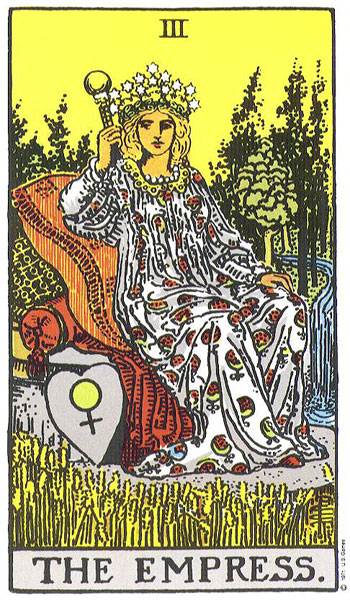
The Empress

The threes relate to the empress. The empress card depicts a woman, likely regnant, seated comfortably and lavishly in a field. She represents fertility, not just for human life but a fertility of ideas and other creations as well. Where the magician provided the spark, and the high priestess gave that spark space and time to develop into a full idea, the empress is the start of binging that idea, that spark, into fruition. That spark is n longer merely thoughts, action beings with the empress.  The empress is the great mother, the understanding sympathiser, the who who brings all things forward into the world, and helps them mature and develop. 


The Threes

So while the twos were about a choice, or a fork in the road, the threes symbolise the beginnings of taking action. This could be the creation of life, romance, art or business. These are the first affirmative steps towards the new beginning. We have chosen a path to take and we've begun upon it. We draw strength. Threes are about starting to put things into action.

The Three of Swords

The three of swords depicts a pierced heart upon the backdrop of a storm. This card may reveal heartache or pain, whether it be from love or from the disillusionment with a  closely held and highly personal belief or feeling. As the swords relate to matters of power and strength and change, the thrice pierced heart relates or reflects the death of something which is closely held. It relates to those things of great importance and likely, great impact on our public persona.

The Three of Wands

 The three of wands depicts a  man arriving at the edge of his land, he grasps on of three wands as he takes in the sights that stretch out over the horizon. He realises that the journey has just begun, but also, that there is still time to turn back - though not for long. The three of wands involves embarking upon a journey, reaching a point where you cannot turn back. It is a card of progress, the first hint that a dream may become real. However the journey has only just begun.

The Three of Cups

The three of cups depicts three maidens celebrating. Being the suit of passion, they are celebrating a joyous occasion, and three being the number of action, it's a new beginning. You are embarking on an endeavour of the heart, this could signify a birth, a new year, a new passion, or a new opportunity for your passion.

The Three of Pentacles

The three of pentacles card depicts a craftsman or tradesmen showing his work to his patrons - the people who pay for his work. Being a card of new beginnings, this may suggest further opportunity for the craftsman.  It's something you've begun to work on that will soon pay off. Your work will be rewarded. Being in the suit of pentacles this card relates to an earthly concern, it could be a focus on your health or your property, or the work on a relationship.  A new beginning stemming from past work, or effort.


Overview: The High Priestess & The Twos

The first step towards gaining a deeper understanding of the Tarot, and something a lot of people forget to do, is to break down the 56 minor arcana cards into 14 groups - the aces, the twos, threes, and so on. So instead of having 56 cards, you only have one set of 14 cards, each with four different suits, coupled with a card from the major arcana as an influence of those cards. In a previous post we discussed the suits and the difference aspect they symbolise, now it's just a matter or leaning the 14 different groups of cards, and their relationship with their "parent" major arcana.

In this lesson, we shall be discussing the twos and the High Priestess

The High Priestess & The Twos


The High Priestess

This card depicts a woman seated between two pillars marked B and J, this represents the word and phrase inscribed upon the pillars in King Solomon's temple. Those words are Boaz and Joachim, the words can loosely be understood to stand for strength and unity. There's a cloth behind the high priestess depicting pomegranates, a sign of prosperity and ambition to the Egyptians, and a symbol of death and the after life to the Greeks. The high priestess holds a scroll, as a keeper of secret knowledge. She holds down the moon, a symbol of mystery, beneath her foot. She does not represent creation, but rather inspiration - the middle ground between the idea supplied by the magician,  and the creation which will be inspired by the empress. 


The Twos

The number two suggests duality, a point between two choices, a fork in the road, our decision as to whether or not a new path will be taken. Twos are the fork in the road. Do you follow the path which takes new ideas into fruition, or do you take the other route? The twos also represent instinctual wisdom, the twos are undirected energy, pure potential waiting to be channelled into a new direction. Do you dare to explore your options.


The Two of Swords

The two of swords show the image of a blindfolded woman with crossed swords, suggesting a clash of ideas or words. Whilst remaining impartial, she holds the swords apart. The querant may feel in the middle of something, caught between two warring people or ideas within their mind. Whilst not choosing sides, the two of swords remains in the middle, at that crossroad, possibly being torn between the two choices.

The Two of Wands

The two of wands shows an image of a man standing with the world in his hands, but it isn't the world s a whole - it's his personal world. He stands between the two wands, his eyes looking exactly between the world he holds in his hands and that which lies beyond. Again, it's a struggle between choices, a journey to be set upon, not for fear nor love nor necessity, but for its own sake.

The Two of Cups 

The two of cups shows two people together, sharing, with one figure taking the cup of the other in exchange. These people are friends, or acquaintances coming together, an unexpected meeting which can change the course or direction. In the background you can see the intertwined snakes, kaduceus. This symbol represents the Roman God Mercury, who was said to watch over the trades. It's a recognised symbol of commerce and negotiation, knowledge of the trades, practical skills, writing and eloquence. So really, the two of cups has a wide spectrum of interpretation. Coming together, brotherhood, trades people, sharing, changing direction.

The Two of Pentacles

The two of pentacles shows the image of  man juggling two pentacles - trying to keep the other from falling, with the balls being tied to a symbol of infinity. The juggler is balancing the physical aspects of his life, be they health, finances or perhaps security. The man seeks to maintain the balls in motion, constantly making choices to keep his life in balance.

Overview: The Magician & The Aces

The first step towards gaining a deeper understanding of the Tarot, and something a lot of people forget to do, is to break down the 56 minor arcana cards into 14 groups - the aces, the twos, threes, and so on. So instead of having 56 cards, you only have one set of 14 cards, each with four different suits, coupled with a card from the major arcana as an influence of those cards. In a previous post we discussed the suits and the difference aspect they symbolise, now it's just a matter or leaning the 14 different groups of cards, and their relationship with their "parent" major arcana.

In this lesson, we shall be discussing the aces. In Tarot the aces are the number ones, they relate to the Magician from the major arcana.

The Magician & The Aces


The Magician

The Magician stands behind his alter with all of the suits in front of him, we see the swords, wands, cups and pentacles. Why? It is because the Magician is the creator of idea and thought. He is the one through which everything begins. This is not the physical creation - (that's the Empress) - this isn't about the breathing of life into ideas, but the very inception of them within the human mind. The aces are the root, or the beginning of every suit, as such it should be pretty intuitive that they symbolize the very first kernel of a new beginning in some aspect of the querant's life. Not the beginning of work, but the very first inkling of a thought that perhaps something of change, perhaps for the better. The Magician is the one who conjures ideas and inspiration from our mind, as if by magic. To me, there is something weird about this idea, and it's really hard to explain. So focus carefully here. The Magician will conjure a thought, for you, and he asks the impossible question: what type of new thought would you like to receive? What theme should I plant in your mind? Well... how can you answer that? Obviously, you can't. The aces represent these types of beginnings that come from some strange, fuzzier, hazy place in our mind that we are scarcely aware of. They are the exposure in the beginning of adoption of a new idea, way of being, or thinking.


The Ace of Swords

The ace of swords represents awakening, a beginning to new large challenges. There may be an awareness of the querant that there's a new challenge or a new goal of epic proportions that is ahead of them. They may just be beginning to see the challenge, or the may have just begun to work towards or away from this occurrence, radically altering their action in light of this new idea or influence.


The Ace of Wands

The ace of wands represents a new passion, it could be religious, philosophical, relating to career about which they're passionate. It could be a new journey, a new battle to overcome, or a new love in their life. Remember, a new love is about passion. As we already know wands relate to that which we're passionate about. Ace of wands represent a new passion somewhere in the querant's life.


The Ace of Cups

The ace of cups represents a new love. This could be romantic love, or a deep passion for an endeavour or idea. They are intrigued, and excited. They are looking forward to the new, not just with their eyes but with their hearts. They feel the pull towards something new and exciting, it captures their imagination and dreams.


The Ace of Pentacles

 The ace of pentacles represents new luck, new luck, new prosperity. It's not flashy or ostentatious, nothing short lived or elusive. The ace of pentacles represents new but solid gains to be made in one's physical self, or the physical world around them. These are long lasting changes such as new friendship, new prosperity or new found health.

Overview of Tarot Suits

To make learning the 78 Rider-Waite Tarot cards easier, I am choosing to first break the cards down into groups. Firstly we divide the cards into two sets - the major and the minor arcana. The major arcana consists of twenty two cards, and each has a number, the first 10 are:
  1. The Magician
  2. The High Priestess
  3. The Empress
  4. The Emperor
  5. The Hierophant
  6. The Lovers
  7. The Chariot
  8. Strength
  9. The Hermit
  10. The Wheel of Fortune
Why is this important? It is important, because each of those 10 cards act as parents for their corresponding numbers within the minor arcana. So if we take The Hierophant - he relates to all the fives within the minor arcana - The Lovers relate to the sixes, and so on. So right there, when doing a Tarot reading, you already have two pieces of information to draw upon for any card that comes up. You'll have two different ways of interpreting it based on the card itself and also to the part on the minor arcana to which it relates. For this reason, we are going to cover the first ten cards of the major arcana and look at them in light of how they influence the interpretation of the minor arcana. I will also be discussing the significance of the numbers themselves. This way, if you choose to use a deck in the future that doesn't have all the pictures you're used to seeing for the minor arcana, you'll still know what to do. After we finish focusing on these first ten major arcana cards, that will leave us with only twelve remaining major arcana cards to learn, so it helps to keep our learning organised.

Each card may represent one or more of four things. It may represent
  1. A person
    Who may be identified by occupation, or role, as suggested by the card's traditional representation of a class of people within traditional medieval life.
  2. An external concept
    Which reflects the world that surrounds the querent (person seeking a reading) or their perception of the world.
  3. An internal concept
    Something of a feeling or an emotion, a belief or an idea within a person
  4. An activity or an action
Now let's take a look at the four different suits within the Tarot, and see what they represent:


The Swords

Historically, the nobility was represented by the swords, which were considered a very expensive items in those times, indicating power and control over others. Swords were wielded by powerful men, those of influence, those whose words alone could change the world as we know it. So when indicating a person, the swords may be referring to someone of high birth, leadership, or power. As an external factor the swords represent an implement of power and change. Swords may indicate to a situation which is changing, perhaps violently - be it physically or emotionally around the querant. Internally, the may refer to sharp logic, painful lessons - the school of hard knocks, mental thoughts of a revolutionary nature. Big plans, maybe even evil plans - dreaming big and big ideas. In terms of activity and action, the swords may suggest the historical intellectual pursuits that were deemed a luxury of the wealthy, such as debate, creativity and the sciences.  Higher education.


The Wands

Historically the wands may represent the middle class, the merchants and trades people, as well as those who have obtained certain comforts within their life. Note that in every image, the wands are sprouting leaves representing new growth, and echoing the growing affluence of this class of people within history. The wands and swords, whilst both being capable of being used as weapons are of a different quality. Whereas swords served a single purpose - the walking stick, or staff or wand serves multiple purposes. It can support tired legs on a long journey, it can be used to defend yourself, and in the case of a wand, it can be used for magic. Or just for pointing at stuff! It is a multipurpose tool, for those who are not rich enough to own a dozen different sticks for different purposes; but still have the leisure and the ability nevertheless to make use of such devices for their own enjoyment or protection. The rising middle-class! As an external factor, wands suggest struggle and hardship endurance, however, this doesn't necessarily indicate a struggle. Surely a long walk, or a journey with a staff in hand need not be a hardship - it can be a luxury. These struggles are not fights against enemies or oppressors, but are much more likely to be an internal struggles or challenges that we take on for ourselves, for our own benefit. As an internal factor wands suggest enthusiasm, grand ideas, passion, desire, restlessness. As staffs, or bats, they may suggest combativeness, hot tempers, challenges of minor struggles, athleticism, or competitiveness with others. Internally walking sticks, staffs, wands, are used to change the world around us, but in a less emotionally violent way than swords. They do so without the fear that a sword brings, but with the understanding still there that the holder of a wand or staff carries with him or her a certain power. Internally they may represent travel from one mindset to another, persuasion towards a different view point, or persuasion in a way that is less turbulent than the swords. In terms of activity or actions, the wands represent travel, adventure, wanderlust, athleticism. Basically, any activity that could be consider leisure, or a leisurely pursuit. 

The Cups

Historically the cups represent religious figures, but are also understood to represent those for whom you have a deep love, feel a great passion. They don't necessary relate to a romantic love, although it could be, but it does represent those who have stirred deep  passionate emotions within you, and create the experiences that impact your heart. It could be someone like a relative, or a very close friend, or someone with whom we share a very deep bond with a spirits or hearts. As an external factor think of the cup as the heart of others being either empty or full of love or spirits. The cup represents things that will either fill or empty the spirit or soul, the things or people that move men's hearts, the thing with which they find passion and strength. Shared experiences amongst others. As an internal factor the cups are about romantic or poetic ideas, things that appeal to our hearts and our spirits. They represent the things that move you forward when you are down, they can relate to a humble spiritualism or a search for beauty, or divine love, particularly the emotions that are identified with love such as sorrow, bliss, passion, nostalgia. In terms of activities or actions the cups indicates someone or something with which the heart is invested. It could be their passion for a hobby or work, or a person for whom you have a passion.

The Pentacles

Historically the pentacles relate to the common person, whose mere existence consisted little more than the day to day concerns of life, the ones who could not travel and were more concerned with putting food on the table than dreams of wondrous travels and adventures. This is about people interested in regular, mundane, ordinary - earthly and physical concerns. These are the cards of the pragmatic hard working people, who may be paid well below their worth, but also possible the person who sabotages their long term future with indulgences, because they see meaningless luxuries as trivial things that take them away from the path of the common person.  The pentacles may also represent someone with whom you're relationship revolves strictly around such concerns as these. Someone like a beggar, a baker, a thief, a person who comes around and makes your life more comfortable, or more miserable, in small ways that don't drastically alter who you are as a person, but are appreciated or not, nonetheless. The pentacles also represent the long slow path to wealth, or to truly long lasting relationships. As an external factor the pentacles involve issues of money, possessions, shelter, the physical well being, material wealth, long term investments.  Our land, our home. Pentacles also represent social interactions and responsibilities, as these too are things that we expect to evolve over time, and extend, and hopefully flourish throughout our lives. They may indicate wealth, poverty, physical possessions, attainment of friendships, social groups, slow steady growth or development. As an internal factor the pentacles involve issues of generosity, greed, sharing, and indicate a sense of hard work, our work ethic. They represent the things we feel compelled to do not out of passion or ego, but simply to put food on the table and to make ends meet, or to maintain our own health and physical well being.  They may reflect our common day-to-day concerns of bills, health, and a steady future. In terms of activities or actions the pentacles represent the long slow path to wealth or truly lasting relationships. The pentacles we consider that in which enriches us and that which enriches others. It is the day to day tasks that we face in the hope of creating something of long term substance, value, and meaning.


This concludes our overview of the Tarot suits. In the coming posts we will focus on gaining a deeper understanding of all 56 cards in the minor arcana, and a result of this organised technique, you will start picking up the first 10 cards of the major arcana with no extra effort at all. I hope this was helpful to you, please feel free to comment, share or bookmark this page for further learning opportunities!


Love Luna Rose